Family Entertainment Center Software

Family entertainment center software

Four attractions. One Saturday. One number.

Karts, simulators, axe lanes, party rooms and a kitchen on one schedule, one cart and one daily close, instead of three systems that disagree about how the day went. A family fun center runs the same way: every attraction on one system.

1basket across every attraction and the bar
Anybookable unit, lane, room, court, bay, table
0extra charge for general-admission headcount
$279starting price, published on this site
Why multi-activity venues call us

Every attraction you add is another system that does not know about the others.

You bought a booking tool for the karts, then another for the lanes when the first couldn’t model them. The POS is a third vendor, parties live in a spreadsheet, and at close, three reports disagree about what you took.

Three systems, one venue

  • A guest books karts online and axe lanes by phone
  • The party deposit sits in the POS and the balance in the booking tool
  • A waiver signed for one attraction means nothing to the other
  • Gift cards work at the till but not online
  • Nobody can answer “what did Saturday actually make?” without a spreadsheet
  • Every new attraction means another vendor evaluation

One platform

  • Every attraction is a bookable resource with its own rules, capacity and pricing
  • One cart takes the karts, the lanes, the room and the pizza in a single payment
  • One waiver, checked before checkout, valid across the venue
  • Gift cards, credits and memberships redeem everywhere
  • One locked daily close, with each day’s QuickBooks journal lines to preview
  • A new attraction is a resource type, not a procurement project
The resource model

We did not hard-code your attractions. You define them.

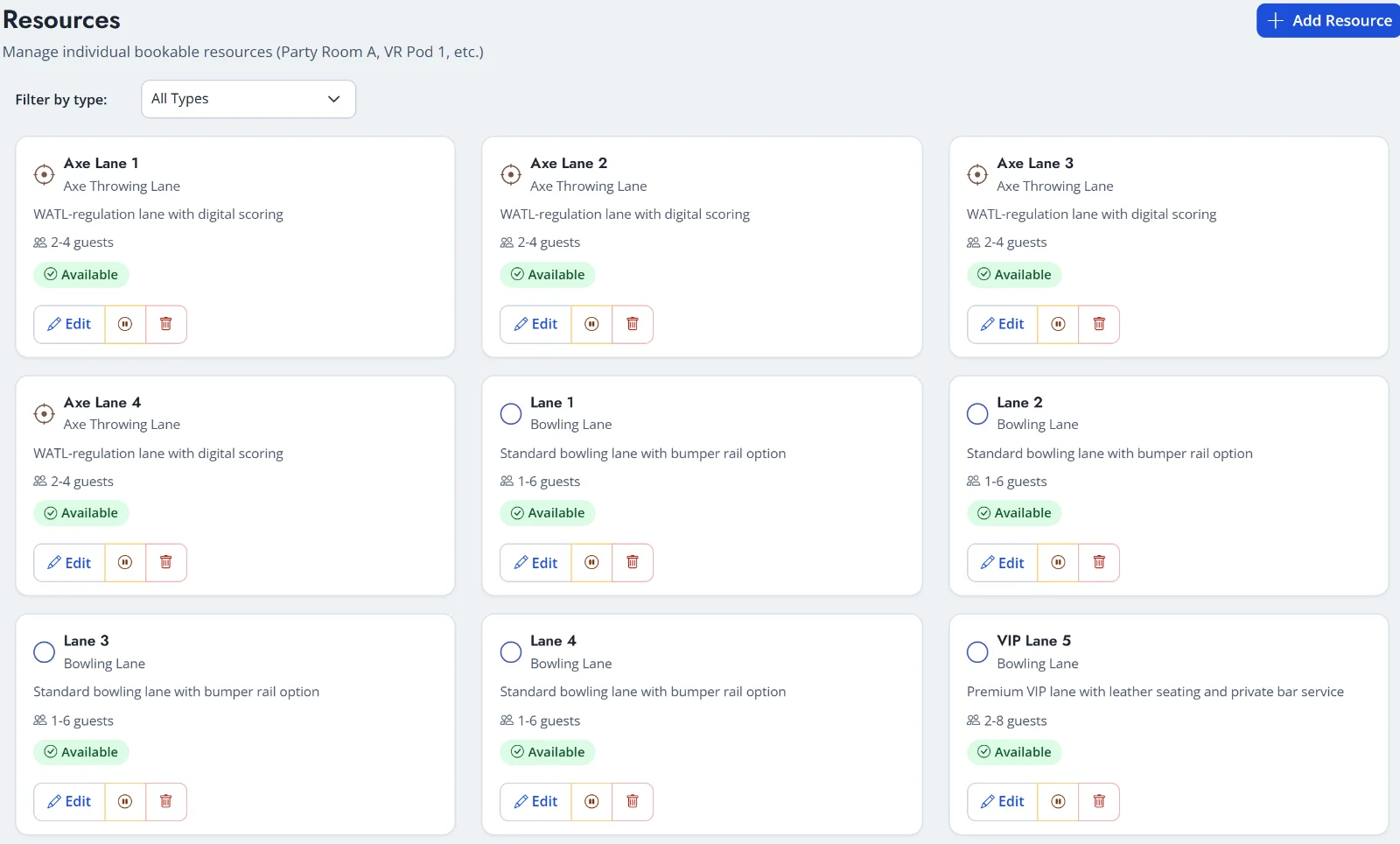
A bookable unit is anything the schedule hands to a guest: a lane, a bay, a court, a room, a table, a kart, a rig. You create the type and set its capacity, eligibility rules, pricing, turnaround time and dependencies. From there, one availability engine answers for all of it.

  • Axe throwing, trampolines, climbing, escape rooms, mini golf, bowling lanes, batting cages, VR: if you can put it on a schedule, it’s a resource type.
  • General admission runs on a headcount. An open-jump session sells against a capacity cap and doesn’t count as a unit, so adding two hundred guests a day costs you nothing more in software. At the kiosk, guests pick a session, see the spots left, pay and get that session’s wristband color.
  • Turnaround time is on the schedule. Clean-down, reset and cool-off time is part of the resource, so the next booking can’t start until the room is ready.
  • Everything a party needs books together. A party that needs a room, six lanes and a host goes in as one booking. If any part of it isn’t available, the whole booking stops and nothing is left half-booked.
  • Eligibility rules are enforced by the system. Each attraction has its own age, height, weight and waiver rules, checked at booking, so the eight-year-old isn’t turned away at the lane after you’ve taken the money.
Axe lanes per lane, per hour
Party rooms with turnaround
Karts & heats per seat
Simulators per bay
Open jump / open play capacity
Tables inside the F&B pack
Instructors & hosts staff as a resource
One engine answers for every one of them.
Resources admin page with cards for axe throwing lanes and bowling lanes, each showing guest limits and Available status
Lanes, bays and rooms you define yourself, each with its own guest limits and status.
Parties & groups

Party booking: the highest-margin thing you sell, run properly.

Parties are usually the part of the business held together with a spreadsheet, a deposit taken over the phone and somebody shouting across the floor about who’s next. Venues that run parties also see meaningfully more repeat visits than those that don’t.

Packages

Included guests, then a per-head price

Birthday party booking needs more than one price field and a note in the calendar. A package carries base, peak, off-peak and member pricing, included guests with a per-person price above that, duration limits, and minimum and maximum guest counts.

Private events

Private events with the price in front of you

Build the event in four steps and watch the quote update as you add activities, food and guests.

Tickets

Each guest pays their own ticket

Set the event to “Each guest pays” and guests buy their own tickets; for anything left over, send a pay-the-balance link or an invoice.

Exclusive use

Book out the whole place

Exclusive use holds the track, the room or the entire venue for a private group.

Changes

Move it without losing anything

Move a private event to another date and everything sold with it moves too. Change the guest count as one number and see the join seats, heats and price before you save.

On the day

Every guest knows where to be next

Each guest gets a live activity guide on their phone showing their next attraction and time. Because every participant is tracked, the host isn’t counting heads to work out who has already thrown.

The bit they remember

Awards and certificates, generated

Group events produce awards, either automatic or picked by your host, plus printable certificates. It costs you nothing, and it’s the thing that ends up on the fridge.

Before they arrive

Waivers done in the parking lot

A group invite sends every guest their own link for details and waivers, so fourteen kids don’t show up with two signed forms and a queue behind them.

Minors

Guardians manage their own children

A parent keeps their children’s details and consents in their own account, ready for the next visit. Guardian consent and the claim process are part of the platform itself, and were never bolted onto racing.

Corporate

Inquiry to booking, tracked

A corporate inquiry from any channel becomes an opportunity with a stage and a close date. It sits on the same record as everything that company has booked before, which beats a starred email.

Food & beverage

The kitchen is not a separate business.

Every minute a guest is in the building but not on an attraction is a minute you can earn from, as long as the tab and the booking are the same transaction.

  • Quick tabs and table tabs, modifiers, comps, voids with reasons, split-tender close, split and combine tabs, auto-gratuity.
  • A kitchen display with zones, QR ordering at the table with no app for the guest to install, and pay at the table: guests split the check, tip and pay by card on their phone.
  • Table reservations run on the same engine as the attractions, and they’re included: tables don’t count as billable units.
  • Tax that behaves: five jurisdiction levels and seven tax types, with compounding and effective dates, so amusement tax on a session and meals tax on a burger follow different rules.
  • Booking credits: a package that includes $15 of food really does buy $15 of food, and it’s tracked properly. Party packs add allowances such as one drink and one snack per guest, spent from each guest’s party pass at the register or kiosk, and the party’s pizzas go to the kitchen ahead of the time you pick, once the party has checked in.
Where we stop, plainly: receipts, guest checks and kitchen tickets print straight from the register on Star printers (CloudPRNT) or Epson printers (Server Direct Print), each kitchen ticket at its own station, with no software at the venue. Without one of those printers, the register opens your browser’s print window instead. Cash drawers have a float, paid outs, drops, a blind count and manager approval, a drawer wired to the receipt printer opens for cash sales, and the daily close can use the drawer counts for over and short. If your kitchen runs on another printer brand, ask us about it early.
tab / party room 2
Party package · 14 guests
includes 2 pizzas, 14 drinks
Prepaid
Extra pizza ×2
$36.00 · meals tax
Tab
Axe lane add-on · 45 min
$180.00 · amusement tax
Tab
Gift card applied
−$40.00 · balance $0.00
Stored value
One close, one ledger
bookings + F&B + retail, same Z-report
Reconciled
Bring your worst Saturday.

Give us your attractions and your party packages and we will build the schedule live on the call. Thirty minutes, on your numbers.

Straight answers

Family entertainment center software: what operators ask us first.

We don’t do racing, just axe throwing and trampolines. Is this really for us?

Yes, for running the venue: your attractions are bookable resources you define, so it works as axe throwing booking software. Waivers, minor handling, guardian consent, parties, packages, group events and food were built for any venue, and none of it was adapted from racing. The racing-specific part is the timing and race-control layer, which you simply don’t license. The one piece that doesn’t carry across is our achievements-and-leaderboards engine, because it runs on lap times, and you’re better off reading that here than discovering it in month two.

How are we charged if we have a lot of attractions?

Booking is $279 a month for online booking, guest accounts and your website, and the full platform is $579 a month with four bookable units included and additional units at $28 each. General-admission capacity isn’t a unit, and neither are F&B tables, which sit inside the food and beverage pack. So a venue with eight axe lanes, five party rooms and a kitchen comes to about $1,090, and adding two hundred open-jump guests a day changes nothing. The full rate card is published.

Can guests book several attractions in one go?

Yes. The multi-activity cart takes karts, lanes, a room and food in one checkout and one payment, and each item stays held for the guest while they finish. If any part is unavailable, the whole booking fails cleanly and nothing is booked.

Can we keep our current point of sale?

You can, but you’d lose the reason to switch. The booking, the party package, the bar tab, the retail sale and the gift card all go through one basket and one set of books, and land in one daily close. Run a separate POS and the reconciliation problem comes straight back.

We have three locations.

Two or three locations work well. Each site has its own inventory, staff, pricing and reporting, and you switch between them. What we do not have yet is one screen that rolls every location into a single figure. If group-level consolidated reporting is your main requirement, we would rather you know that now.

Can we add karts or simulators later?

Yes, and that’s the point of buying a platform over a booking tool. Capabilities are licensed modules: add the karting or sim racing pack when you need it, and the platform sets up its screens and pages for you on the customer records you already have. Karting · Sim racing.

See it on your venue

Bring your worst Saturday. We’ll run it.

Give us your attractions, your party packages and your busiest hour. We’ll build the schedule, run the parties and close the day with your numbers, in a site branded for your venue.

Thirty minutes. No slide deck.

From the newsroom

New capabilities that matter to party and multi-activity venues.

Related pages

Depth on the individual attractions, and what the whole thing costs.